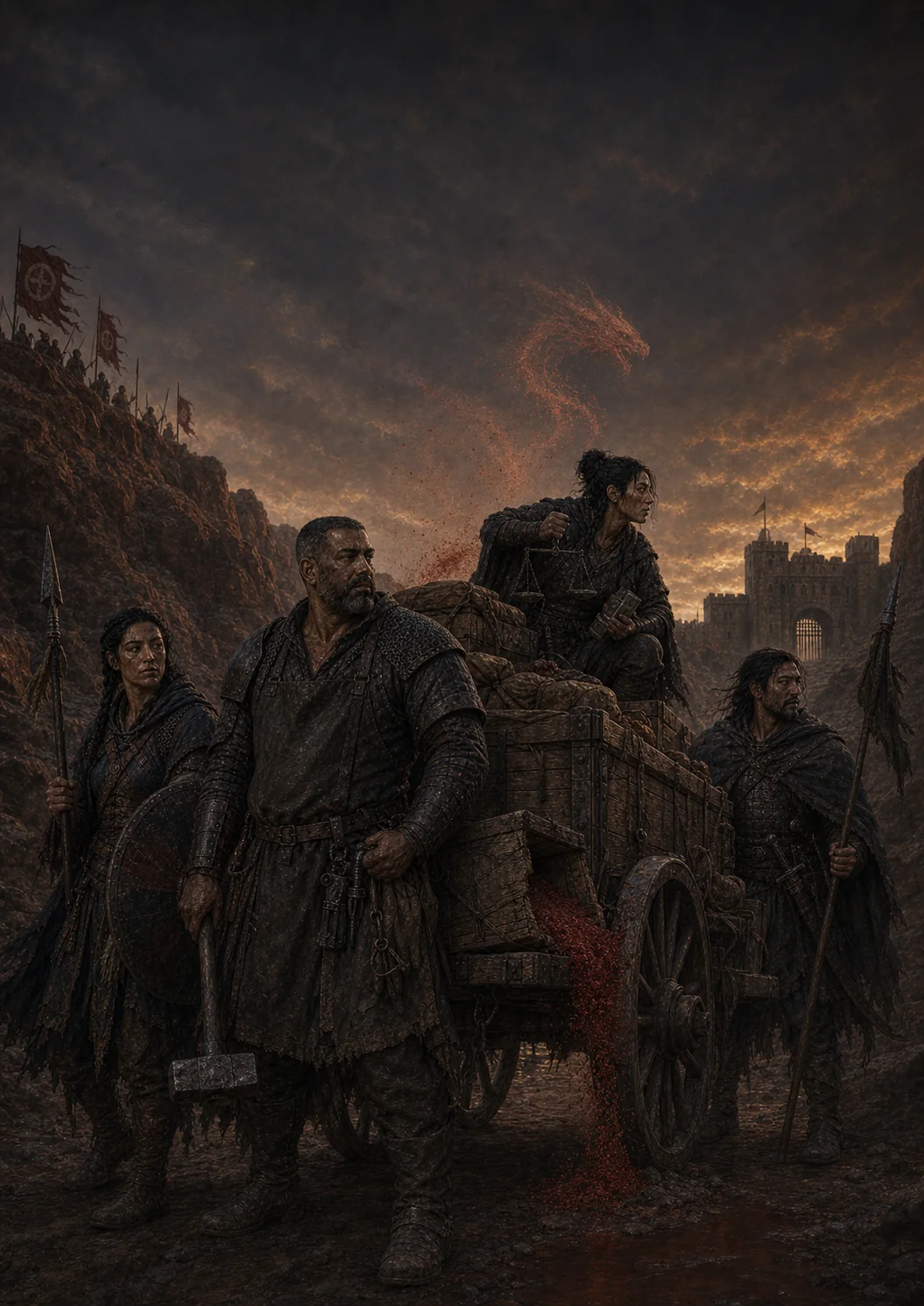
Before the Rain Bell
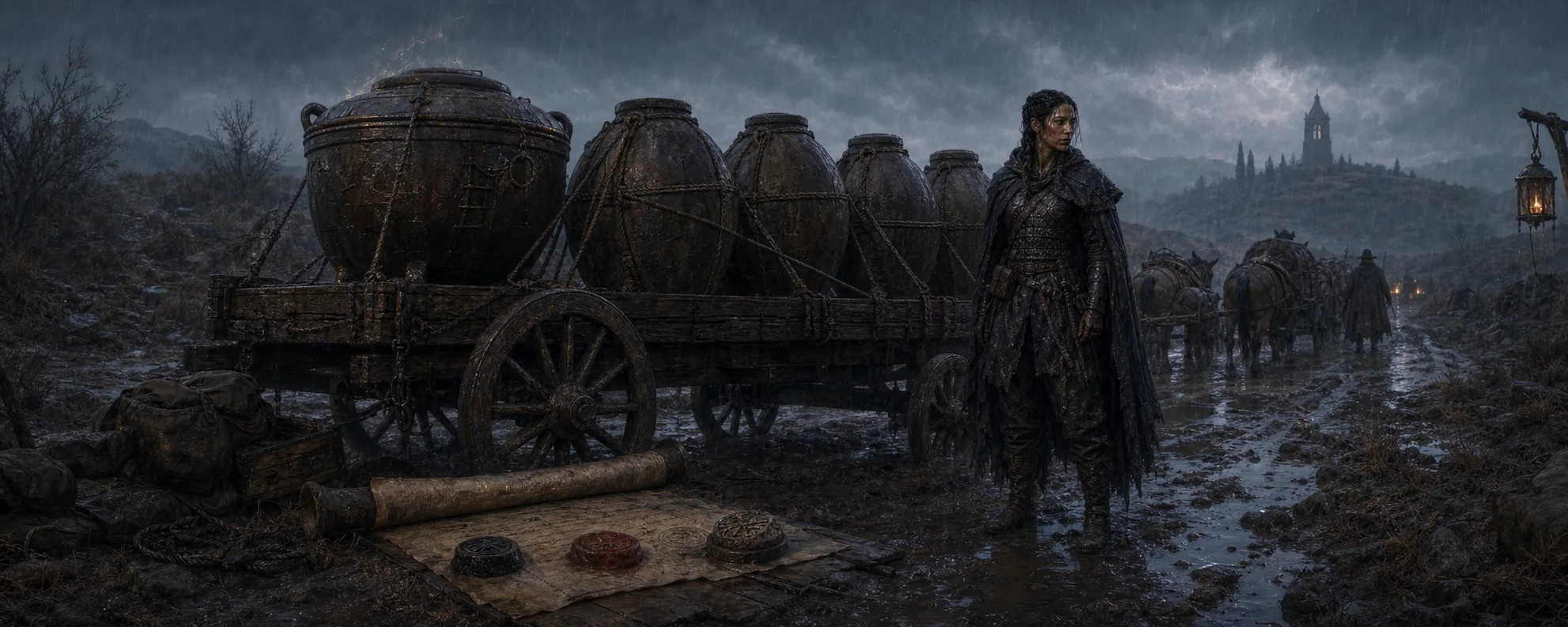
Before the north wind turned, an ancient spice cauldron and four sealed jars had to reach the Frost River treasury. The contract had been written three times—in guild black, frontier vermilion, and a ritual script no one could read. Its three seals waited like mouths ready to swallow the name of anyone who broke it.
Cenya tucked the contract back beneath her breastplate. One heavy wagon carried the cauldron, shaped like a bronze heart under lock. Another carried one jar each of Red-Crown Saffron, Mist-Silver Cardamom, Quiet-Night Clove, and Wind-Weeping Cassia. Oilcloth could not contain their scents; they quarrelled through the dusk of the Salt-Mirror Waste.
The Copper Scales called the cauldron an expensive device for safely blending the four true spices. Miners said it warmed by itself whenever someone cried for help beneath a cave-in. Cenya did not know which account was worth more. She knew both sides would kill for it.
“Ten gold crowns if the cauldron and all four jars reach the treasury intact,” said her officer, Lorn, reciting the clauses from horseback. “Six if the cauldron and at least two jars arrive. If the cauldron is damaged or only one jar remains, we owe twelve. The company flag and horses become guild property.”
“You missed the last clause.” “Which one?” “The guild accepts no responsibility for deaths on the road.” Lorn looked along the company. Ninety-seven soldiers remained: wagon veterans, skirmishers on both flanks, spears in the rear. Each had a line in the pay ledger. The contract gathered them all into the phrase necessary escort labour. “That is not a clause,” he said. “That is how merchants breathe.”
A copper whistle sounded ahead. The skirmishers had found a barefoot child beside a broken marker, hands raised, white wrist cloth grey with sweat. The Throat-Stone mine to the north had collapsed. More than forty rescued miners now burned with fever, and the well tasted of rust. A little Mist-Silver Cardamom could cleanse the water; Quiet-Night Clove might quiet whatever heat had awakened below.
The company cursed—not because the villagers were unworthy, but because every mercenary understood the arithmetic. Break a seal and lose the intact-delivery bonus. Deliver too little and the living had no winter boots, the dead no compensation. The child pressed his forehead to the salt earth. “We will pay.” The amount would not buy the copper clasp on a jar.
Cenya looked northwest. An unnatural red stained the horizon, as though something behind the hills breathed slowly. She ordered the child to travel with them as far as the waystation. She promised nothing and refused nothing. The first lesson a mercenary learns is not how to kill. It is how to make an answer arrive later.
The Rider of Bloodright

Before nightfall, riders in white-scaled cloaks overtook the wagons. Their horses wore cloth around their hooves and raised almost no salt dust. Their leader, Fur, named herself the daughter of the last Springward bloodline in Salt-Mirror Valley. She carried no military writ—only a vial of ancestral blood and a cauldron covenant older than the kingdom.
“The cauldron is not guild cargo,” she said. “The Springwards used it to blend spice and divide water for the whole valley. The guild repaired its wheels and declared ownership. The frontier army means to brew a season of war spice without asking those buried in the spring fields.”
Fur pricked a finger and let blood fall upon the covenant. Faded lines shone like roots. The bronze cauldron answered with a low note. Some spearmen knelt to the miracle itself; others gripped their weapons, afraid the miracle would next demand obedience. The Copper Scales would call it an unregistered mechanical response. A temple might call it blood-witness. Once different people gave the same sound different names, it grew different laws and armies.
“The blood proves standing,” Cenya said. “Is that not enough?” “Enough to prove the cauldron remembers you. Not enough to prove everyone who ever used it belongs to you.” Cenya herself had no surname. A wind bell spoke a forbidden family name on the night of her birth; her mother fled with her and died at the hands of a blood-tithe officer. Cenya had always treated bloodline as stolen property she could neither sell nor return.
Fur looked toward the jar of Wind-Weeping Cassia. All seven seals swelled toward Cenya as if a face behind the clay listened to her breathe. “Blood of the Sky-Chime,” Fur said. “All the more reason to return the cauldron. The army will widen the war with red spice. The Scales will turn every shortage into a price. You know whose blade this contract is sharpening.”
Lorn laid the delivery contract between them. “If we surrender the cargo, we become raiders. The next city will not ask why. It will read the warrant.” Fur offered an exchange: bring the cauldron to the ancestral spring before the rain bell. If her blood received no answer, she would withdraw. If the cauldron acknowledged her, guild, army, and valley folk must meet and read the old covenant again rather than let mercenaries decide ownership beside the road.
“You trust the land to judge?” Cenya asked. “No,” Fur said. “I trust it to remember who bled first.”
The Third Flag
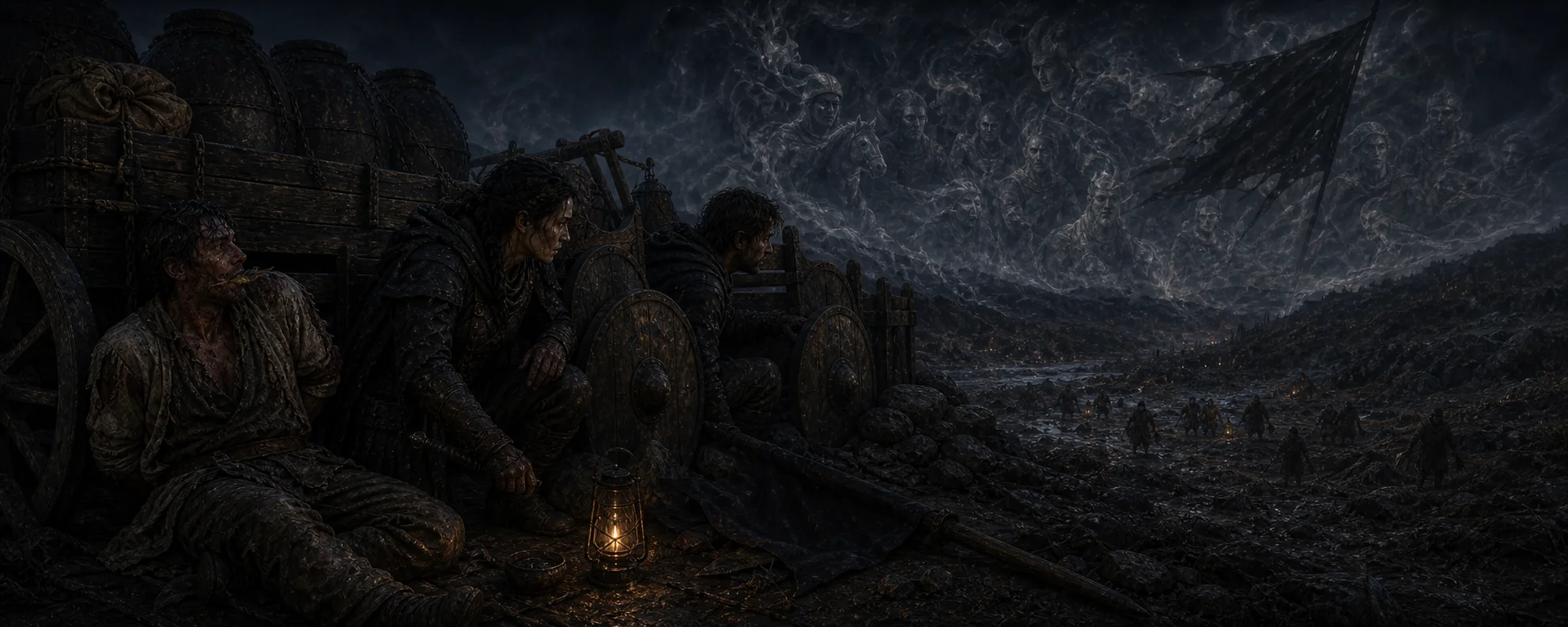
A contrary wind rose that night. Cenya dreamed that someone beneath the earth struck a bell; with each stroke, a banner that did not exist fell from the sky. When she woke, Lorn had captured a scout with tobacco packed in his cheek.
Tobacco burned fear into zeal and taught the eye to manufacture evidence for desire. The scout swore a thousand saints waited beyond Salt Ridge. The skirmishers saw only a dozen hired killers employed by a Copper Scales factor. They meant to burn the cauldron covenant and the cardamom, then blame Fur. The cauldron could still reach the army while healing spice became a scarcity sold only at guild prices.
Cenya ordered the veterans to lock shields between the wagons, the skirmishers into a dry gully, and the spears to remain visible by the fire. “Use the cassia?” Lorn asked. Opening it forfeited the sealed bonus. Leaving it closed meant the contrary wind would swallow their signals. “Use people first,” Cenya said.
The first flag narrowed the shield wall. The second drew the spears back. The third should have sent the skirmishers into the enemy flank—but an arrow dropped the standard-bearer. As oil jars crossed the ridge, Cenya cut her palm and pressed blood to the witness seal on the Wind-Weeping Cassia.
It was an old seal from the cauldron covenant, not a general art by which any blooded heir could command spice. She never opened the jar. The seal borrowed her blood and sounded once. Wind rose from cart beds, shield gaps, and dead horses’ manes. Cenya heard the flag ropes, the breath of nine skirmishers below, and the slosh of oil in the enemy jars. She struck the flagstaff down, and the wind carried the command into bone.
The skirmishers sprang from the right. Spears drove forward. Veterans opened their wall just enough to admit enemies who could advance but not turn. The wind blew fire back across the ridge; tobacco smoke revealed every hiding place. Victory was not clean. Kemo took an arrow in the neck. A recruit stepped into flame. The skirmisher captain was speared through the thigh. Some enemies knelt; others kept calling to saints that existed only in smoke.
When weapons fell, the wind began reporting names to Cenya: Kemo. Ivan. Little Cape. Morrel, the enemy soldier dying on a spear, whose daughter in Westport had just learned to walk. Nanja, once a Salt-Mirror miner, who took the killing contract to pay a debt. The names could not be proven and would not be refused. They were not wounds, but remained more certainly than wounds.
Lorn bound her hand. “What does the blood demand?” “That I remember where an order lands.” She could have called it an ancestral gift and let the soldiers own the victory. Lorn knew that any tale speaking only of gifts and never of price was usually preparing a lie for the next levy. “For how long?” Cenya looked at the quiet seal. “It did not say I may forget.”
What Can Be Sold and What Can Be Saved
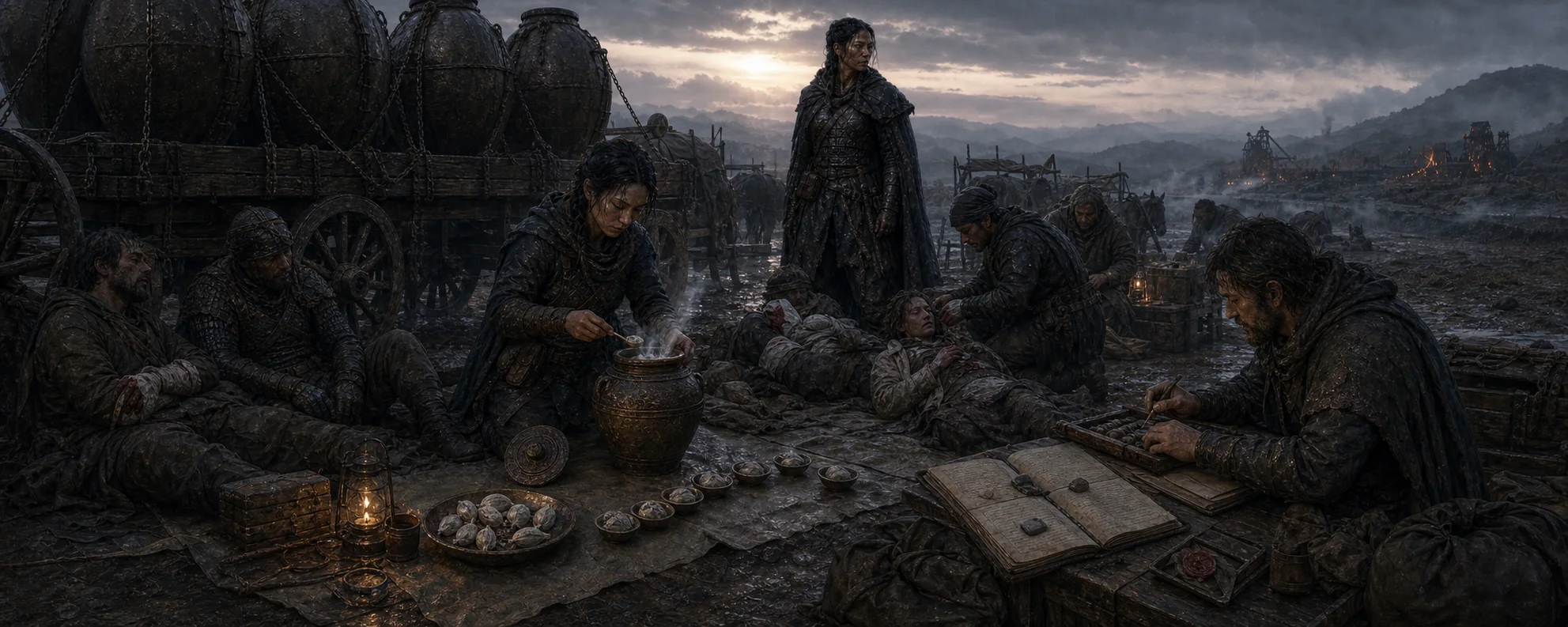
By morning, the red light above the mine was closer. The wounded lay side by side on oilcloth: eleven from Ashen Ember, seven from the enemy. The surgeon had only common styptic herbs. The skirmisher captain’s leg was blackening. A prisoner with lungs full of tobacco smoke clawed at the air and called for his mother. The dead needed no medicine, but still needed shrouds, graves, and money sent home.
The jar of Mist-Silver Cardamom stood thirty paces away. The paymaster set an abacus on the wagon: break the seal and lose four crowns; use half the cargo and the buyer might reject the rest. Money was not another word for greed. It was winter boots, compensation, arrow shafts, fodder—the promise that ninety people might stand beneath the same flag next time.
“Save only ours,” a veteran said. “No one could blame us.” “Save those who can still walk,” said the surgeon. “The badly wounded may not survive even if—” He stopped. The captain was awake and heard him.
“You do not have to make the same merciful decision for everyone,” Lorn told Cenya. “A captain makes decisions for everyone.” “No. A captain decides and then cannot pretend someone else chose the cost.” People watched the wounded, the abacus, or Cenya, waiting for her to turn an impossible choice into an order. If a captain stayed silent, infection, price, and time made the decision instead.
She ordered the accounts recalculated in public. Open the cardamom. Prepare twelve doses. Treat company and prisoners by injury, not flag. Send the remainder to Salt-Mirror Village in return for mine maps, two mule carts, and hands to carry the wounded. If the guild withheld pay, Cenya would surrender her captain’s share. The rest became a named Blood Debt held by the company against the Copper Scales, supported by testimony, prisoners, and ledgers.
No one cheered. The paymaster cut the seal and placed the wax—worth four crowns—into an evidence pouch. He recorded each dose twice: one ledger named the life it saved; the other named the pay the company lost. The first kept mercy from becoming legend. The second kept sacrifice from becoming free.
Cardamom filled the air like the first mouthful of winter well water. The wounded did not rise healed, and the red light did not vanish. When magic is truly needed, it often does no more than leave one more step possible.
The Ancestral Spring Does Not Decide Ownership
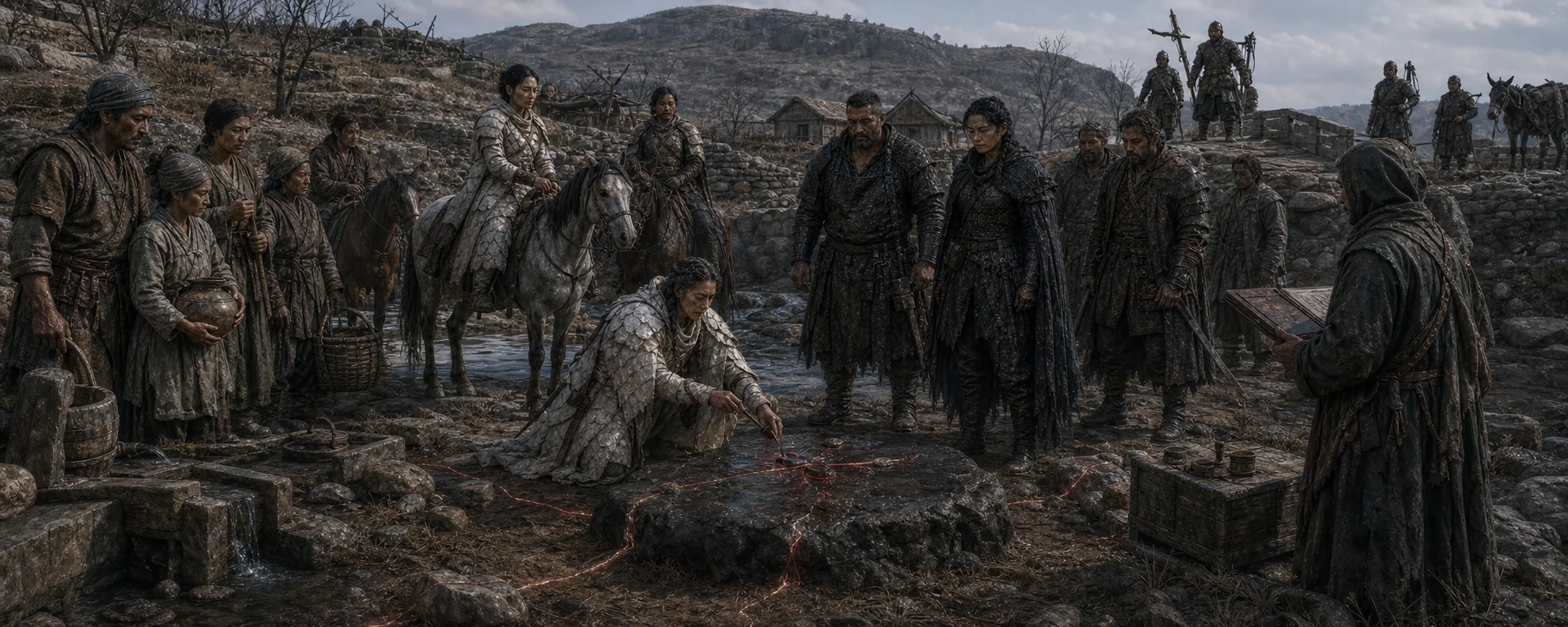
At noon the wagons reached the ancestral spring. Springward riders, villagers, and guild clerks waited west of the altar. The northern commander’s crossbows held the eastern bridge. No one drew first. Every side believed its paper, blood, cargo, or bows should make the others withdraw.
Fur poured ancestral blood onto black stone. Old boundary marks lit beneath it. The dry spring sighed underground and the cauldron trembled. “Under the cauldron covenant, the Springwards must oversee it for the valley.” The commander raised a requisition writ: “Under wartime law, anything that can brew war spice belongs in the arsenal.” A Copper Scales clerk opened a ledger: “The guild paid to excavate, repair, and transport it. Investors possess the right of sale.”
Each claim held part of the truth. Blood remembered the oldest oath. The army had defended the north bank. The guild had rescued the cauldron. Yet every account turned miners, carters, spice growers, and the dead into scenery, as though only those who applied seals had ever touched it.
Fur asked Cenya to witness the covenant with Sky-Chime blood and offered the Ashen Ember Company land, pay, and permanent place as its guard. It was good enough to be frightening. Lorn did not answer for her; an officer is not a captain’s conscience speaking by proxy. He asked, “If we accept, do we guard one bloodline or everyone who needs the cauldron?”
The wind reported more names, including people not yet dead but who might be written into it by a season of war spice. Cenya laid the delivery contract, cauldron covenant, opened medicine jar, and arson testimony upon the altar. “My blood can witness the old covenant. My flag can deliver the cauldron to the army. The prisoners can prove the guild broke faith. Each lets me choose a master. None gives mercenaries under drawn bows the right to decide generations of ownership forever.”
She proposed a Winter Inquest Deposit. Cardamom and clove would treat the wounded and seal the mine heat. A neutral Stone-Bell temple would hold the cauldron until a public winter hearing. Blood evidence, requisition, repair accounts, miner testimony, and the Ashen Ember casualty roll would all be copied openly. Saffron and cassia would remain sealed; any faction seizing them first would lose its right to speak at the hearing.
It was not eternal peace. It narrowed what swords could decide today and preserved what testimony might change in winter. The temple could be bribed. Witnesses could disappear. Ashen Ember still had to survive long enough to deliver the copies.
“By what right do you withhold what is not yours?” the commander asked. “By standing between the cauldron and your bows,” said Cenya. “That is not ownership. It only keeps today from sentencing forever. Refuse, if you like, and see who can first afford the battle.” The crossbows did not move. The mercenaries held no unbeatable formation, but no one could wipe last night’s blood from the negotiating table.
A Deposit Covenant Must Use Old Ash
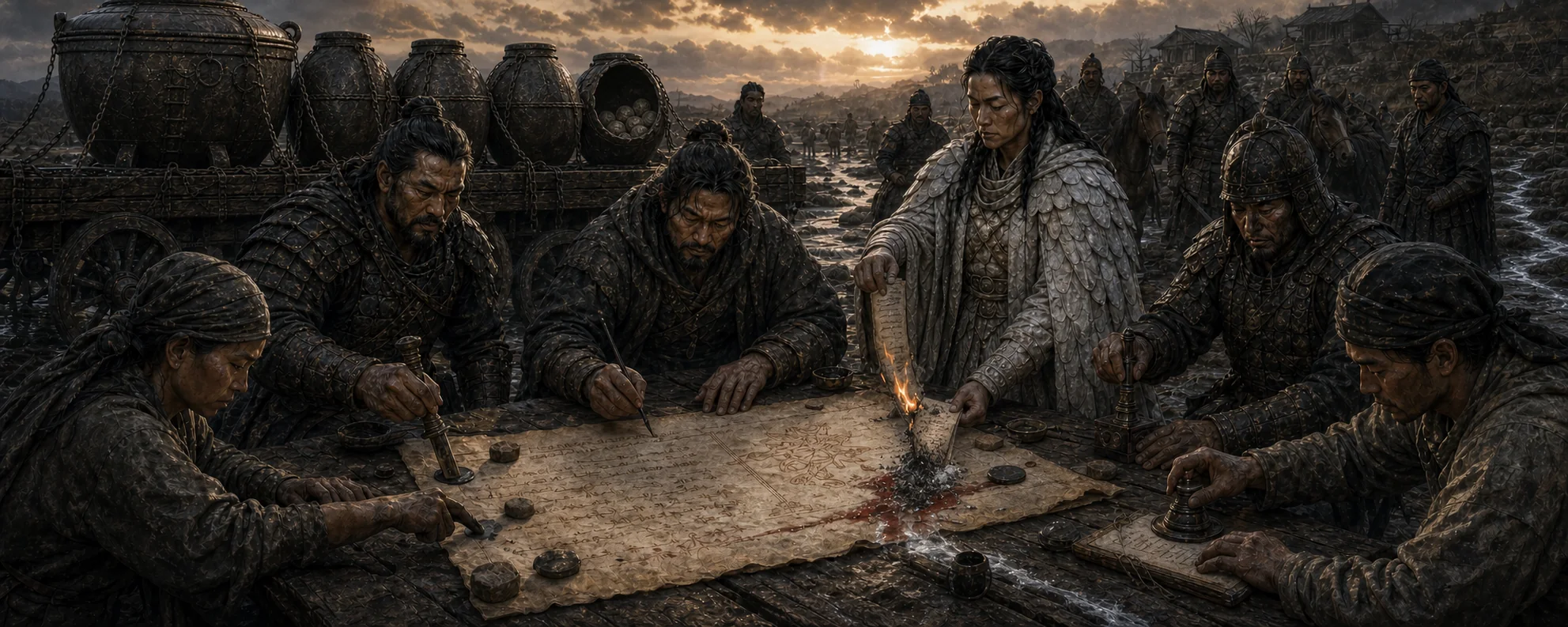
The deadlock lasted until the sun crossed the altar. The Copper Scales clerk yielded first—not from conscience, but after calculating what the arson testimony would cost three northern trade roads. He offered compensation if the record said a local factor exceeded his authority rather than the guild hired killers. The village accepted this incomplete truth in return for water carts, miners’ compensation, and three years of public repair accounts. No one mistook compromise for innocence.
The northern commander withdrew the bridge crossbows and sealed his requisition at the Stone-Bell temple until the inquest. He had not surrendered the cauldron. He had only made the army tear its own royal seal in public if it chose to seize it.
Fur spoke last. “If I accept the deposit, the covenant acknowledged by my blood must stand trial beside merchant accounts and military writs.” “The cauldron has already been touched by army walls, guild roads, miners’ graves, and spice growers’ hands,” Cenya said. “Keep the covenant. Admit that blood must answer other testimony.”
Root-shadows still glowed beneath Fur’s feet. One refusal would draw every white-scaled sword, yet none of the miners’ families behind her asked for war merely to possess the cauldron now. Fur put one corner of the covenant into the altar’s cold flame and burned only the line that said no outsider might question its witness. Ash sank into blood. Clear water rose from the dry spring and ran around their boots toward the village. The altar named no righteous owner. It accepted a real sacrifice.
They wrote until dusk. Lorn converted elegant promises into clauses that could be pursued: which road the cauldron would take, how the four jars would be sealed, who could copy testimony, which soldiers must stay away before winter. Villagers used fingerprints, soldiers sword rings, Fur ancestral blood, the commander his royal seal, and the guild clerk a lead mark signifying credit rather than innocence.
Every mark left a crack through which responsibility might escape. Lorn did not pretend parchment could abolish betrayal; he made betrayal something that might later be named with a person, date, and price.
The commander asked under which title Cenya would sign: Sky-Chime heir, Ashen Ember captain, contracted carrier, or witness of the Winter Inquest? Each title offered one future and told others how to pursue her. She wrote only Cenya, for the ninety-four names still alive in the pay ledger, and required every identifiable dead soldier from both sides in an appendix.
“One is missing,” said the paymaster. “The prisoner who could still speak this morning. No one knew his name.” The wind supplied it. The cardamom had not saved him in time. Cenya wrote the name into the appendix.
The Wind Still Keeps Accounts
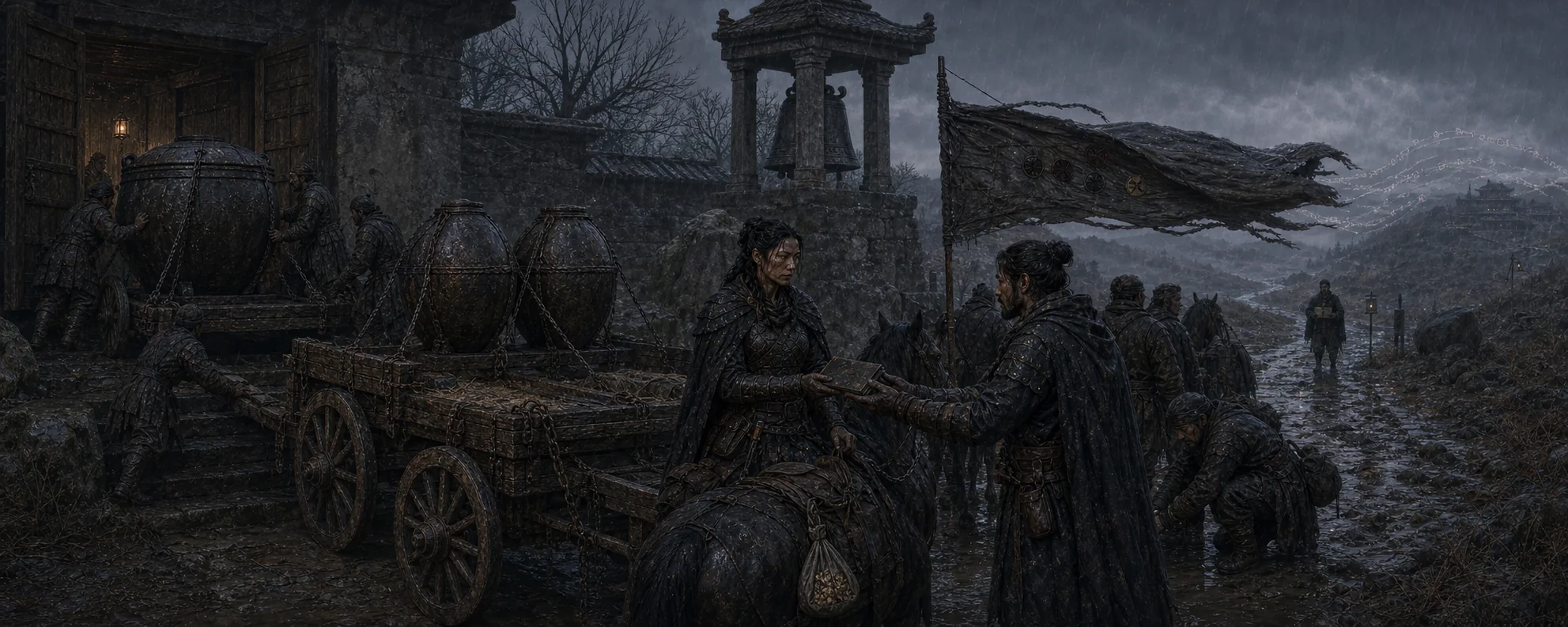
When the rain bell rang, the ancient cauldron and two sealed jars entered the Stone-Bell temple. The cardamom and clove had been opened for the wounded and the mine.
Under the first contract, Ashen Ember had defaulted. Under the deposit covenant, the army did not immediately receive war spice; the Copper Scales preserved a claim at the inquest; the Springwards placed their covenant into public evidence; Salt-Mirror Village received medicine and water carts. Ashen Ember won compensation, winter boots, and a new escort clause that no longer wrote deaths as no responsibility accepted.
No faction received everything it first demanded, so each declared itself wronged. The commander called the temple an obstacle to war. The guild said public repair accounts injured business. Fur said an ancient covenant had been forced to sit beside bills of sale. Lorn said that usually meant the deposit had survived its first day.
As the company left, the child who had begged beside the road brought a sack of dried cardamom husks. They were worth nothing and retained only the faintest cool sweetness. “The well is drinkable,” the child said. “The mine still burns, but Fur and the miners are preparing to seal it. At the winter hearing, they will ask who first fed the cauldron’s fire.”
Cenya tied the husks to her saddle. The Wind-Weeping Cassia was now evidence locked in the temple, commodity and restraint at once. The inquest might award the cauldron to Springwards, army, guild, or the workers who maintained it. The deposit promised no victorious ending.
She did not even know whether she would return to testify. Blood required her to remember names. Contracts required her to leave one. A mercenary life kept urging her toward the next person able to pay. The wind continued to report names—real dead, unborn possibilities, or a tormenting voice in her blood. Lorn gave her a small book: find families for names that could be verified; leave blank pages for those that could not. Do not call uncertainty a prophecy, and do not pretend an uncertain voice was never heard.
“This account will never balance,” Cenya said. “A Blood Debt is not meant to balance,” Lorn replied. “It makes power unable to pretend it was free.”
The wagons crossed the last salt rise. Behind them, the Stone-Bell temple closed the cauldron vault. Ahead, another messenger waited with another contract. Soldiers guessed at pay, camp, and battle; complained that their new boots were stiff; stitched fallen companions’ badges to the flag; and calculated how much wine the spent cardamom might have bought. Cenya let them.
Blood enters the body and carries names no one chooses. Blood leaves the body and writes into the world what people have earned together. Between them, spice is weighed, sealed, burned, used to heal, used to kill—and valued by whoever holds it.
Wind caught the Ashen Ember flag. This time it neither rose nor fell. It stretched toward a road not yet travelled, and everyone still alive had to follow.